
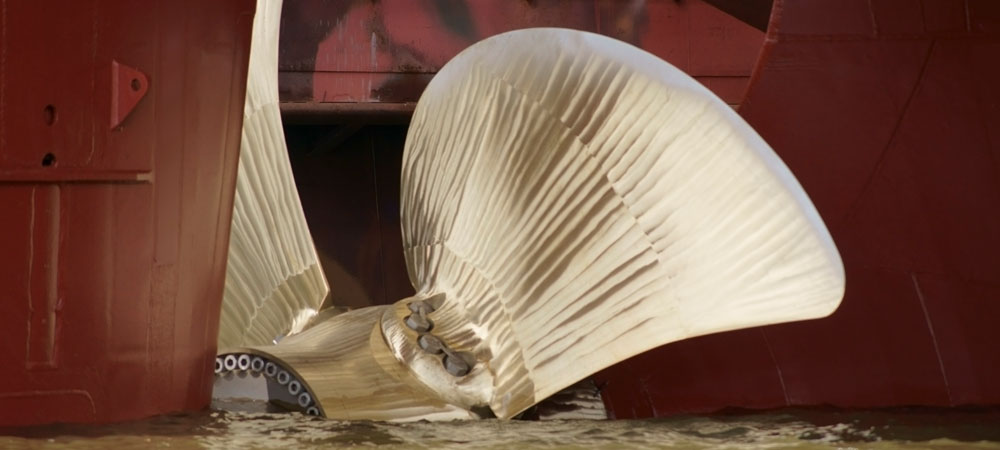
ENVSonic running-gear antifouling keeps propellers, shafts, rudders, stabilisers and thrusters at blade-design efficiency with transducers on the shaft log, rudder stock and thruster tunnel and nothing in the water flow. Blade fouling is the second major factor in consumption and emissions after the hull, and the only way to hold propeller efficiency is to keep the blade clean.
Where fouling bites
Blade roughness is the second major factor in consumption after the hull, and it bites at a smaller scale: a thin layer of slime on a propeller costs efficiency long before shell appears. Shafts, rudders, stabilisers, thruster tunnels, jet drives and nozzles are difficult to coat well, difficult to clean in the water and expensive to polish, so most operators accept a declining efficiency curve between dockings.
How ENVSonic protects it
Nothing is fitted in the water flow. Transducers bond to the structure adjacent to the gear, on the shaft log, the rudder stock, the stabiliser housing and the thruster tunnel, and the ultrasonic energy carries through the metal to the wetted surfaces. The result is blade and surface efficiency held at design with no polishing cycle and less vibration from fouled, unbalanced running gear.
- Propellers and shafts: driven from the shaft log and A-bracket structure.
- Rudders and stabilisers: transducers on the stock and housing inside the hull.
- Thrusters, jet drives and nozzles: tunnel and housing bonding, protected without docking.
Installation
Bonded internally via the proprietary footprint: no drilling, no welding, no docking for most installs. Running-gear protection is usually specified together with the cooling-system channels on the same ENVS1 module, so a four-channel workboat system covers strainers, pipework and the shaft line from one control module. S/Y Encore has run that configuration on propellers, shafts, rudders, stabilisers and raw-water pipework since 2013.
Running gear as a niche area
Propellers, propeller shafts, stern tube seals, rope guards, rudder hinges and thrusters are all niche areas in IMO’s 2023 Biofouling Guidelines, inspected for growth and for the working of whatever protects them. On tugs, ferries, workboats and yachts ENVSonic protects the running gear from inside the hull; on large deep-sea ships running-gear protection is partial and scoped vessel by vessel. Niche areas and the biofouling management plan →
What changes in service
Efficiency held between dockings, the polishing line removed from the maintenance budget and smoother running at rated power. Configure the channels for your vessel → · Estimate the return →
Is anything fitted on the propeller or in the water flow?
No. Transducers bond to the structure adjacent to the gear, on the shaft log, rudder stock, stabiliser housing and thruster tunnel, and the ultrasonic energy carries through the metal to the wetted surfaces.
Does the propeller still get protected while the engine runs?
Propeller protection is active while the vessel is stopped or on standby, which is when fouling settles. An engine-run signal isolates the propeller transducers during operation; sea chest, cooler and hull channels run continuously.
Can running gear share a module with the cooling system?
Yes. Running-gear protection is usually specified together with the cooling-system channels on the same ENVS1 module, so a four-channel workboat system covers strainers, pipework and the shaft line from one control module.
Is there in-service evidence for running gear?
S/Y Encore has run ENVSonic on propellers, shafts, rudders, stabilisers and raw-water pipework since 2013 and passed full survey with its seawater systems clean through.