
The problem
A film a fraction of a millimetre thick
Seawater is free cooling, and it is alive. Within days of start-up a bacterial film forms on every wetted surface. In a heat exchanger that film insulates the tubes, so approach temperatures drift and the process runs hotter or slower. Then larvae settle on it: barnacles, mussels and tube worms that narrow the pipework and block tubes, strainers and screens.
Plants have fought this with chlorine for generations. It works, and it brings a dosing plant to run, chemicals to store and handle, and limits on what may be discharged back to the sea. The alternative is mechanical: take the exchanger off line, pull the covers and clean the tubes, on a schedule the process has to be planned around.
Stationary assets have it worst. A cooler that lasts a docking interval on a ship under way can foul visibly within months on a barge, a terminal or a floating plant that never moves.
How it works here
Sound through the metal, not chemistry in the water
Transducers bond to the dry outside of the equipment: the exchanger shell and end covers, the pipe wall, the strainer body. Short bursts of ultrasound travel through the metal and act at the wetted surface, where they stop the film forming and larvae settling. Nothing enters the water, so there is nothing to dose, store or discharge. The technology in depth →
- Heat exchangers and condensers. The aim is heat transfer held near design and a longer run between openings, shown on your own approach temperatures.
- Cooling-water and intake pipework. Transducers are spaced along the outside of the pipe, each on a footprint shaped to the pipe’s outside diameter.
- Strainers and intake screens. Baskets and screens stay open, so the clean-out round stops setting the maintenance plan.
- Box coolers on barges and floating plant. MRL Resources specified ENVSonic at build for four 184 m processing barges.
It is not a cure-all, and we say so at survey. Ultrasound protects the surfaces the metal carries it to. From the P&ID, the equipment drawings, the materials and the wall thicknesses we tell you what a system will protect, what it will not, and how the result would be measured.
Where it goes on a cooling loop
- Control cabinet: 100 to 240 VAC, remotely monitored, tied into plant SCADA.
- Cooling tower basin: transducers on the outside of the basin wall.
- Heat exchanger: transducers on the shell or end covers.
- Intake and pipework: transducers on the outside of the pipe wall. No penetration and no shutdown to fit.
A stationary asset in service, and the independent research
The hardware
What goes on the wall
One wall-mounted cabinet in a non-hazardous area such as the switch room or the plant room. Inside are ENVSonic control modules on a DIN rail, four or six channels each. Every channel is tested and calibrated every day, and a module that needs attention can be isolated on its own breaker while the rest keep running. Cabinets are built from 6 to 54 channels, and the transducer cables leave through the bottom to the exchangers, pipework and strainers.
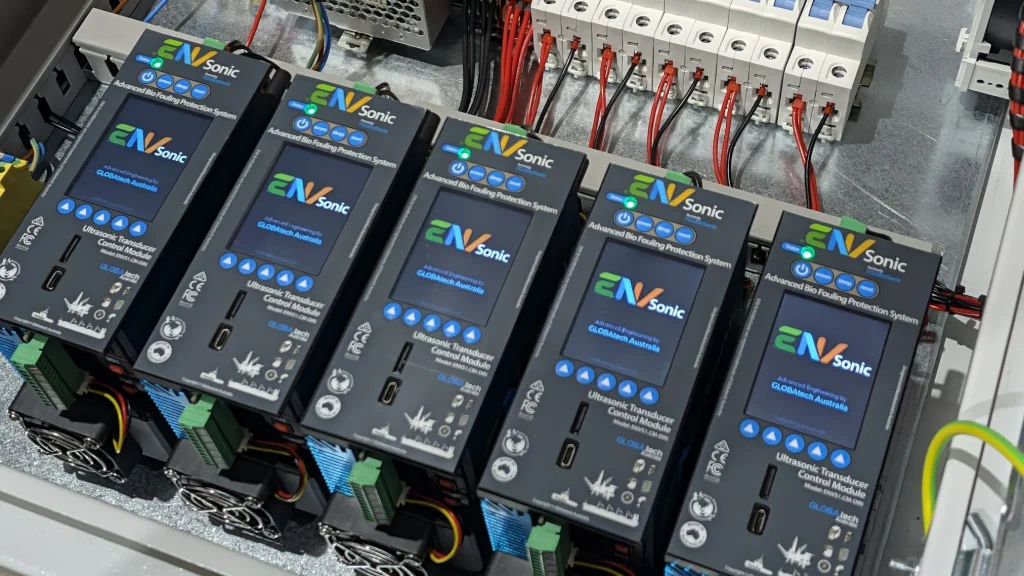
In a running plant
Start with one exchanger
- No shutdown to fit. Nothing is drilled, welded or opened. Transducers bond to the outside of equipment that stays in service.
- A trial you can read on your own instruments. One exchanger or one train, against a twin left as it is, measured on approach temperature, pressure drop and the interval between cleans.
- Keep the existing treatment until the numbers are in. Dosing elsewhere on the system carries on unchanged during a trial.
- It checks itself. Every channel is tested and calibrated every day, and a transducer that loses its bond is detected and shut down. ENVS2 adds remote monitoring through the dashboard and SCADA.
- Runs on plant power. 100 to 240 VAC, in wall-mounted cabinets of 6 to 54 channels with cables entering from below.
Three questions to ask any supplier
- What exactly will it protect on my equipment, and what will it not? Ask for it in writing, against your drawings, before any order.
- How will we both know it is working? Ask how each channel is verified daily, and which of your own measurements the result will be judged on.
- Who stands behind it in year three? Ask who designed it, who holds the certification for the complete system, and what the warranty covers.
Can ultrasound replace chlorination of a seawater cooling system?
On the equipment it is fitted to, it is designed to control biofilm and settlement without dosing. How far dosing can be reduced across a whole system depends on the layout, so we survey first and agree how the result will be measured. A sensible start is one exchanger, with the existing treatment kept everywhere else until the numbers are in.
Does the plant have to shut down to install it?
No. Transducers bond to the dry side of the vessel, shell or pipe wall through the proprietary footprint, so there is no penetration and no shutdown to fit.
Is it certified for hazardous areas?
No. ENVSonic is certified FCC, CE and RCM as a complete system and is installed in non-hazardous areas. If the equipment sits in a classified zone, tell us the classification at survey and we will say plainly whether it can be protected.
What do you need from us for a survey?
The P&ID, the exchanger and pipework drawings with materials and wall thicknesses, the seawater temperature range, and the present treatment and cleaning record. We reply with what can be protected, a transducer count and a proposal.
Is there independent evidence that ultrasound controls biofouling in heat exchangers?
Yes. A study held in the US Department of Energy’s OSTI archive reports that non-chemical treatment with ultrasound and ultraviolet extended the period of low fouling rates in heat exchangers, and peer-reviewed work shows power ultrasound reducing algae at pilot scale. The research →