
The problem
Warm water, light and nutrients
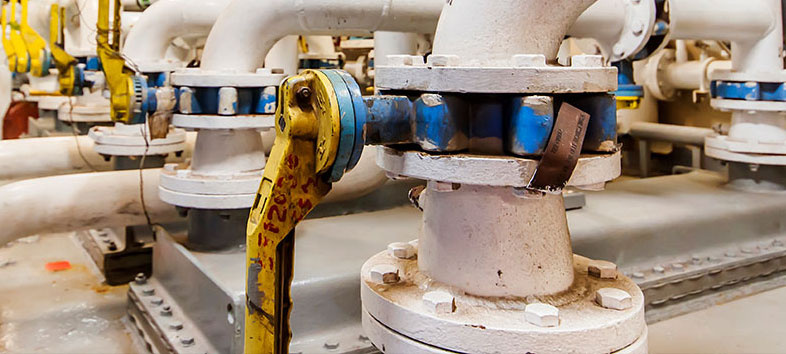
A cooling tower gives algae and bacteria everything they need: warm water, air, light and a steady supply of nutrients. Biofilm coats the basin, the fill and the exchanger surfaces, heat transfer falls, and the film shelters the bacteria underneath it from the chemicals meant to control them.
The conventional answer is dosing: a recurring cost, chemicals to store and handle, water that is harder to reuse, and counts that still drift upward between doses. In aquaculture the same growth closes intake screens and pen netting, in water where chemicals are not welcome at all.
How it works here
Ultrasound from outside the equipment
Transducers bond to the dry outside of the basin wall, the exchanger shell or the pipe. Short bursts of ultrasound travel through the wall and act on the wetted surface and the water beside it, where they disrupt algae and stop biofilm establishing. Peer-reviewed work on power ultrasound shows significant reductions in algae at pilot scale, and over two years in open water. The research →
- Cooling tower basins and chillers. Basin walls and exchanger surfaces kept clean, with the aim of a lower chemical load and longer intervals between cleans.
- Heat exchangers and process pipework. Surfaces held clean so heat transfer stays near design.
- Aquaculture intakes and pens. Screens kept open without chemicals in the water.
Ultrasound works alongside the site’s water-treatment and risk-management plan. It does not replace statutory controls, including those for Legionella; it removes the film that makes them harder to meet. We agree with you at survey how the result will be measured, on your own plate counts and inspection records.
Where it goes on a cooling loop
- Control cabinet: 100 to 240 VAC, remotely monitored, tied into plant SCADA.
- Cooling tower basin: transducers on the outside of the basin wall.
- Heat exchanger: transducers on the shell or end covers.
- Intake and pipework: transducers on the outside of the pipe wall. No penetration and no shutdown to fit.
Independent research on ultrasound, algae and biofilm
The hardware
What goes on the wall
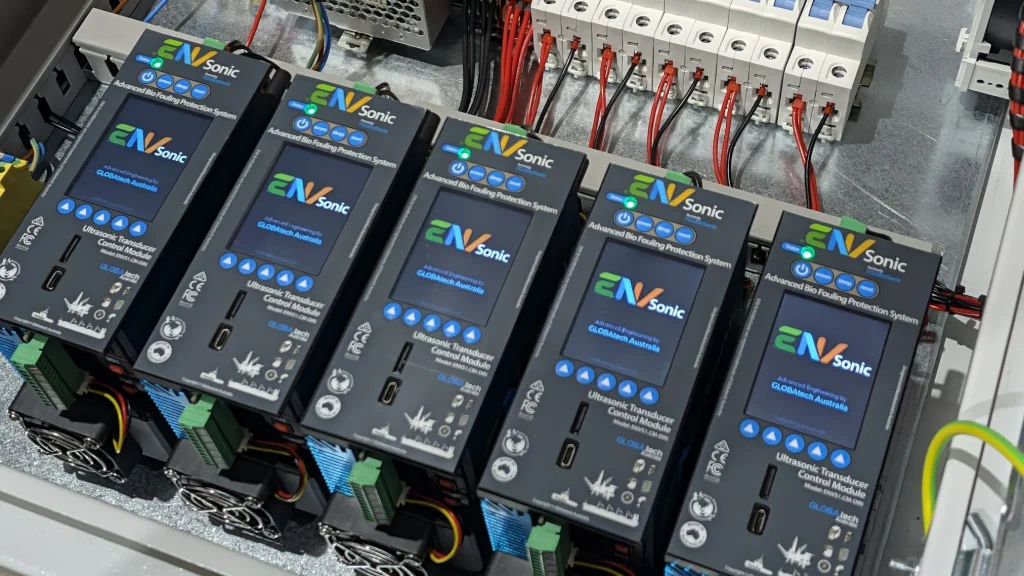
One wall-mounted cabinet in the plant room. Inside are ENVSonic control modules on a DIN rail, four or six channels each. Every channel is tested and calibrated every day, and a module that needs attention can be isolated on its own breaker while the rest keep running. Cabinets are built from 6 to 54 channels, and the transducer cables leave through the bottom to the basin, the pipework and the exchangers.
In a running plant
No shutdown to fit
- Nothing is opened. Transducers bond to the outside of the basin, shell or pipe, so there is no penetration and no shutdown.
- It checks itself. Every channel is tested and calibrated every day, and a transducer that loses its bond is detected and shut down. ENVS2 adds remote monitoring through the dashboard and SCADA.
- Runs on plant power. 100 to 240 VAC, in wall-mounted cabinets with cables entering from below.
- Start small. One tower or one loop, measured against its own record, before the rest of the site.
Seawater-cooled process plant has its own page: heat exchangers and seawater cooling →
Can ultrasonic treatment replace chemical dosing in a cooling tower?
It is designed to reduce the chemical load by stopping algae and biofilm establishing. How far dosing can be cut depends on the tower, the water and the site’s treatment plan, so the reduction is agreed and measured with you rather than promised in advance.
Does it control Legionella?
ENVSonic is not a Legionella control measure and does not replace the statutory controls for a cooling tower. It keeps surfaces free of the biofilm that shelters bacteria, which supports the site’s existing water-risk management plan.
Does the plant have to shut down to install it?
No. Transducers bond to the dry side of the basin, shell or pipe wall through the proprietary footprint, so there is no penetration and no shutdown to fit.
Does it work for aquaculture intakes and pens?
Yes. The same ultrasonic treatment keeps intake screens and pen netting open without chemicals in the water, which matters where the water is a food-production environment.