
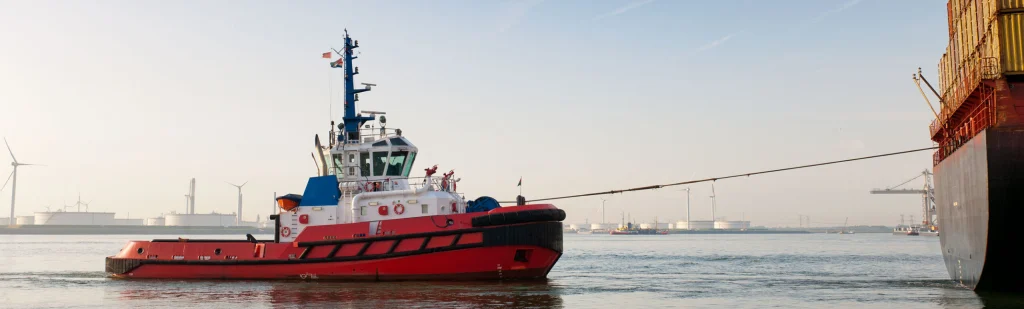
The problem
Idle time is fouling time
Harbour tugs, crew boats and offshore support vessels spend most of their hours waiting: alongside, on standby or holding station. Larvae settle when the water is still, so the cooling system of a working tug sees far more fouling pressure than that of a ship on passage.
It shows up in a familiar order. Strainer baskets fill between clean-outs. Box-cooler capacity drops and jacket-water temperatures creep up. An engine alarms or derates on a hot day, in the middle of a job. Then a diver is booked, or the vessel loses a day while the coolers are opened, and the cycle starts again.
Fouling on the hull and around the thrusters adds a cost that is harder to see: more fuel for the same pull and the same transit, every hour the engines run.
What it protects
From the sea chest to the thrusters
- Box coolers and sea chests. Transducers on the dry side of the chest and the cooler keep the tube bundle and the chest clear, so cooling capacity stays where it was at delivery.
- Strainers and raw-water pipework. Baskets stay open and flow holds through the engine room.
- Thrusters, nozzles and shaft lines. Transducers on the structure beside the gear carry the energy to the wetted surfaces. Nothing sits in the water flow.
- Hull plating. Transducers on the inboard side of the plating keep the coating clean between dockings.
A typical workboat seawater system runs four or six channels from one ENVS1 control module on the vessel’s own 12 or 24 volt supply. Larger vessels, and those protecting the hull as well, combine modules in a cabinet of up to 54 channels. Cooling systems in detail →
Where it goes on a harbour tug
- Control module: in the engine room, on 12 or 24 VDC.
- Sea chests: transducers on the dry side of the chest.
- Box coolers and strainers: transducers on the casing, outside the water flow.
- Hull plating: transducers on the inboard side, spaced along the hull.
- Running gear: transducers on the shaft log, rudder stock and thruster tunnels, inside the vessel.
What tug fleets measured
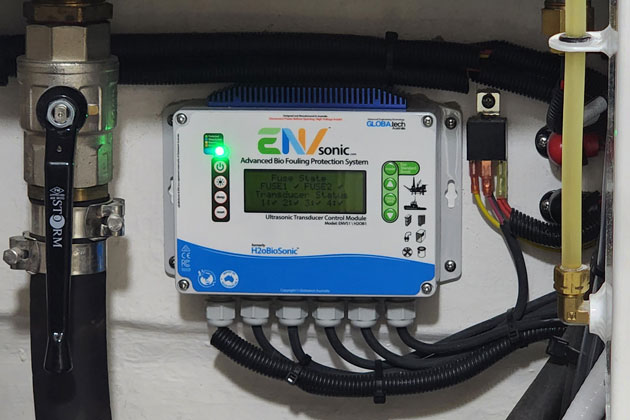
Asia-Pacific tug fleet: from a two-tug pilot to standard fitment across 25
Pilot validated in service; ENVSonic now standard on every newbuild from the designated builder.
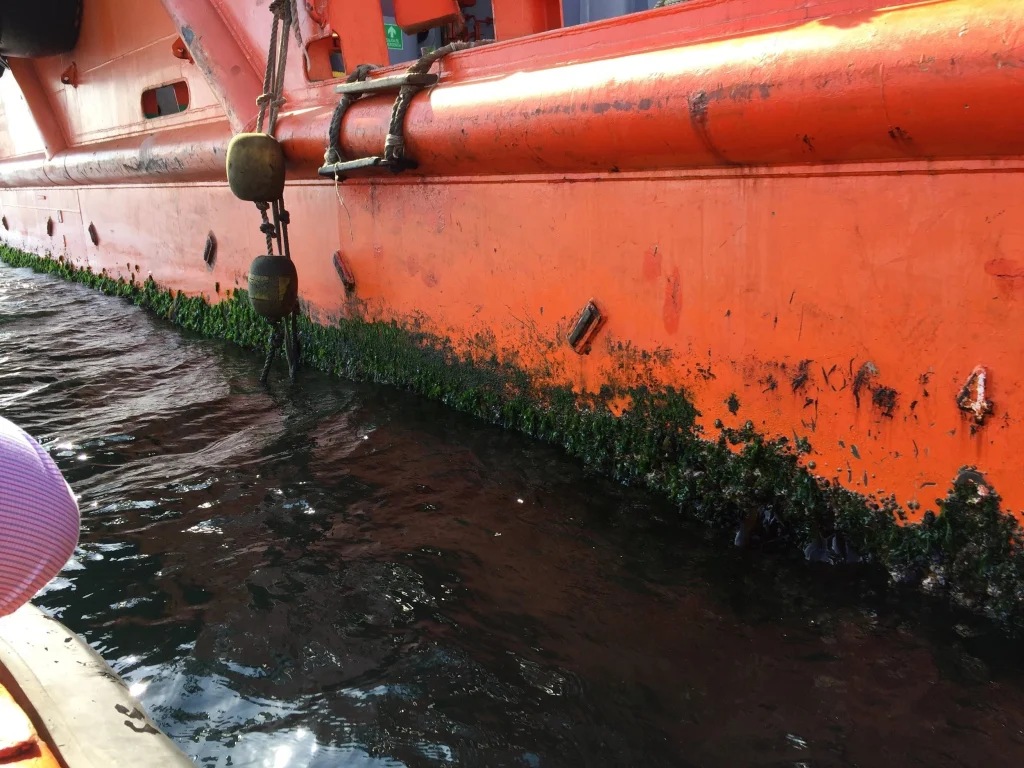
Chilean harbour tug fleet: fuel per engine hour held steady for 18 months
Fuel per engine hour held steady on fitted tugs while the unfitted tug rose 27%.
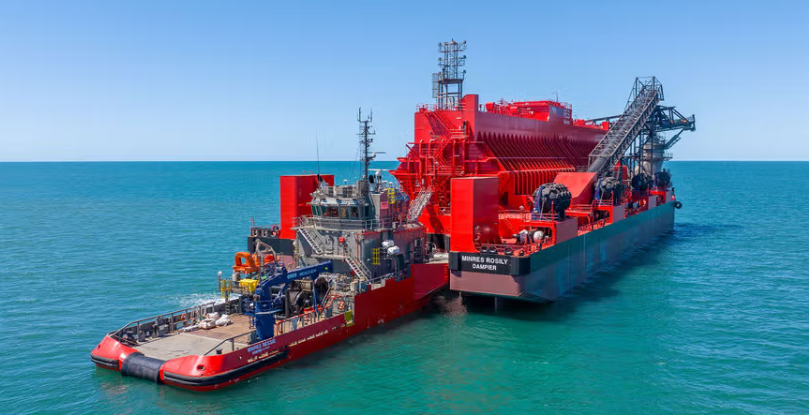
MRL Resources: four 184 m stationary processing barges
Box coolers protected across the asset life on the hardest fouling profile in commercial maritime: an asset that never moves.
In a working fleet
Fitted between jobs
- No docking for most installs. Transducers bond to the inside of the structure, so a tug is fitted alongside and goes back to work. Nothing is drilled or welded.
- It checks itself. Every channel is tested and calibrated every day. A transducer that loses its bond is detected and shut down, and the crew sees it on the display.
- One standard across the fleet. The same module and transducers fit every class, so spares, training and the install method are common. An Asia-Pacific towage operator went from a two-tug pilot to more than 25 tugs in five classes this way.
- Supported for its working life. Three-year warranty on the complete system, five with a Monitoring & Maintenance plan.
Three questions to ask any supplier
- How do I know every transducer is working today? Ask how each channel is checked, how often, and what the crew sees when one stops.
- How much energy reaches the steel? Ask for the energy delivered into the structure, not the watts on the label, and how the mount is qualified.
- Who stands behind it in year three? Ask who designed it, who holds the certification for the complete system, and what the warranty covers.
Our own answers are on the technology page and in the warranty.
Does ultrasonic antifouling work on a tug’s box coolers?
Yes. Box coolers are the most common ENVSonic application. Transducers bond to the dry side of the cooler and sea chest, with no drilling of the pressure vessel. An Asia-Pacific towage operator runs it as standard on more than 25 tugs, and MRL Resources specified it at build for four 184 m processing barges.
Can a tug be fitted without docking?
In most cases, yes. Transducers bond inside the vessel, so the work is done alongside between jobs. Cable runs into ballast tanks are the exception: they need class-approved penetrations and are planned for a docking.
How many channels does a harbour tug need?
It is confirmed from the general arrangement and the cooler and strainer drawings. A typical workboat seawater system runs four or six channels from one ENVS1 module; protecting the hull and thrusters as well takes more. The configurator gives an indicative count.
Does it run from the tug’s own supply?
Yes. ENVS1 runs natively on 12 or 24 VDC, with an optional 100 to 240 VAC input. Each transducer is driven at its full 60 W rating in short bursts, which averages 6 to 8 W.
What does it do to fuel?
On a Chilean harbour tug fleet, the first fitted tug held its fuel per engine hour within about 5% for 18 months after docking, while an unfitted tug in the same fleet rose 27%. Read the case →