
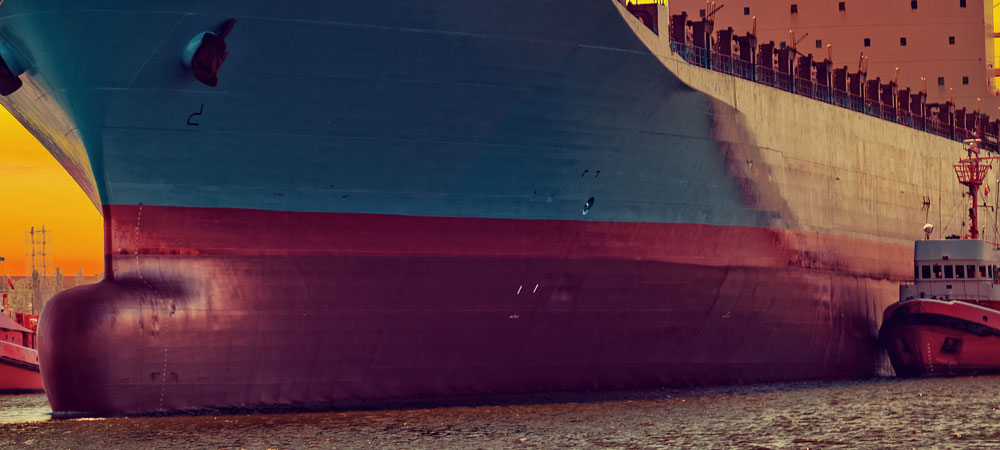
ENVSonic hull antifouling stops settlement on hull plating and submerged structures before it starts, keeping the hull at as-painted condition between dockings with transducers bonded inside the plating and nothing in the water. Hull fouling drives hydrodynamic losses, longer passages and higher consumption, and it compounds: diver cleaning damages paint and accelerates the next growth cycle.
Where fouling bites
A meaningfully fouled hull adds between 10% and 30% to fuel burn at constant speed, and the penalty compounds: slime becomes weed, weed becomes shell, and each diver clean roughens the paint and shortens the time to the next one. For a fleet modelling its CII path, hull condition is the largest lever it can pull without changing the fuel or the route. Ballast tanks, pontoons, jetties and intake structures foul for the same reasons and are rarely cleaned at all.
How ENVSonic protects it
Transducers bond to the inside of the plating via the proprietary footprint, in a pattern set from the general arrangement and the frame spacing. The ultrasonic energy travels through the steel or alloy and forms non-inertial cavitation at the wetted face, so settlement is stopped before it starts and the coating stays at as-painted condition between dockings. Hull plating on tugs, ferries, OSVs, yachts and workboats is protected by ENVS1 modules and cabinets of 6 to 54 channels, the same hardware as the seawater systems; on large deep-sea ships ENVSonic protects the sea chests, coolers and pipework today, and the ENVS2.sXDCR MAX smart transducer for the deep-sea hull is the next release.
- Hull plating: the coating protected rather than replaced by the antifouling; no diver cycle roughening the paint.
- Ballast tanks: transducers inside the tank structure; cable penetrations require class approval and are planned at docking.
- Pontoons, jetties and intakes: fixed structures that never see a dry dock, protected continuously.
Installation
Internal bonding to plating; no through-hulls, no welding and no penetrations outside ballast tanks, so most hull installs happen in service. One retrofit covered two Australian Ro-Pax ferries with an active fouling problem, scheduled around the timetable and commissioned in operational sequence. Newbuild spec-in starts from the GA: we return a transducer plan, cable schedule and integration drawings for the yard’s electrical package.
What changes in service
Fuel burn and attained CII back on the as-painted curve, shorter trip times at the same power, longer docking intervals and a hull that passes niche-area inspection without an in-water clean. Estimate the fuel, CO₂ and CII effect for your vessel → · See the measured results →
How much fuel does hull fouling cost?
The published range for a meaningfully fouled hull at constant speed is 10% to 30% of fuel burn, and the penalty compounds as slime becomes weed and shell. ENVSonic keeps the coating at as-painted condition between dockings so the attained CII stays on the design curve.
Does ENVSonic replace antifouling paint on the hull?
No. It protects the coating rather than replacing it: transducers bonded inside the plating stop settlement so the paint is not roughened by diver cleaning, and docking intervals extend.
Does a hull installation need dry docking?
Most do not. Transducers bond to the inside of the plating with no through-hulls or welding. The exception is cable penetrations inside ballast tanks, which need class approval and are planned at a docking.
What size of hull can ENVSonic protect?
ENVS1 modules and cabinets of 6 to 54 channels, the same hardware as the seawater systems, protect hull plating on vessels up to about 100 m: tugs, ferries, OSVs, SOVs, rig support vessels, pilot boats, yachts and workboats. Equipment for the hulls of large deep-sea ships is coming soon: the ENVS2.sXDCR MAX smart transducer, with registration of interest open on its product page. On deep-sea ships today, ENVSonic protects the sea chests, box coolers and pipework.