
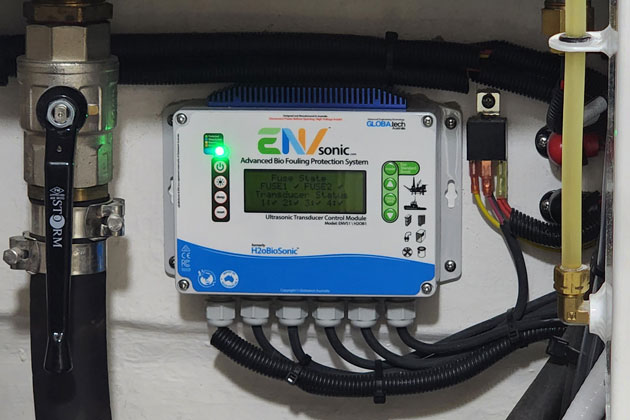
A two-vessel pilot in 2021, protecting raw-water strainers, pipework, plate exchangers and hull, became standard ENVSonic fitment across more than 25 tugs in five classes from a single designated builder. The daisy-chain architecture cut install time by roughly five times against multi-cable systems.
The problem
The operator runs one of the most demanding harbour and escort tug operations in Asia-Pacific, with several newbuild classes in flight at its designated builder at once. Tugs spend most of their hours alongside or at low speed in warm water, so raw-water strainers, pipework and plate exchangers foul first and the hull follows. For a fleet operator the question is never whether an antifouling system works on one boat; it is whether it can be specified, installed and supported across a class without slowing the build.
What changed
It started small: two tugs in 2021 with raw-water strainer, pipe and plate exchanger protection plus hull. The vessels performed, the operational case was validated in service, and the specification expanded with each class. The protected fleet now spans harbour and escort tugs, further ASD tugs, a firefighting tug and newbuilds entering the fleet under standard ENVSonic fitment.
The result
More than 25 tugs across five classes, with ENVSonic now standard fitment on every newbuild from the designated builder. Three lessons carried into every fleet programme since:
- Installation has to be faster than the alternative. The daisy-chain architecture cuts install time by roughly five times against legacy multi-cable systems; with several newbuilds at one yard that is the difference between specification and rejection.
- Per-channel data earns trust at the chief engineer’s level. The operator’s engineers see operational data for every transducer through the remote monitoring platform.
- Newbuild integration locks in the lifetime relationship. Each protected vessel is covered for the life of the asset.
Run it on your fleet
This is the operating model we repeat with every Tier-1 tug operator: a small pilot with agreed measurements, validated outcomes, an expanded specification, then standard fitment across the class. The pilot programme → · ENVS1 for tugs and fleets →
Named fleet references are available to prospective customers on request.
More from tug fleets: Chilean harbour tug fleet: fuel per engine hour held steady for 18 months.