
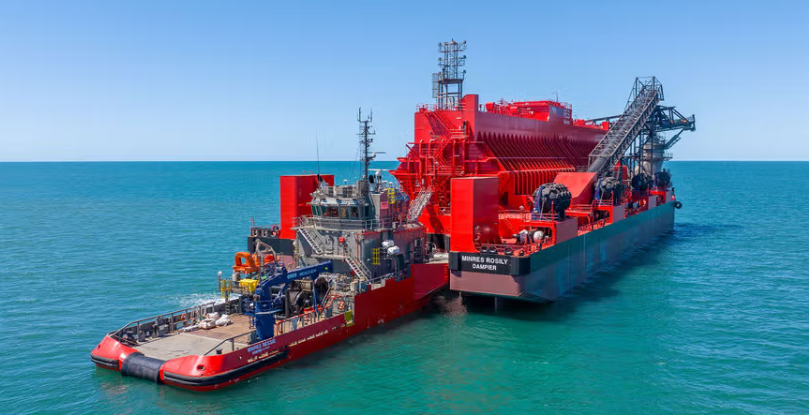
Four 184-metre stationary processing barges built at COSCO between 2022 and 2023 were specified with ENVSonic box-cooler protection before delivery, running from fit-out through sea trials, the delivery passage and the long stationary deployment in warm Australian waters. Continuous protection with no in-water cleaning campaigns and no cooling degradation.
The problem
Operators usually model antifouling around a vessel at design speed. A stationary processing barge has no design speed and no operational flow. It sits in warm coastal water with sea-chest intakes drawing continuously for the box coolers that support the processing plant, and every minute of every day biological matter settles with nothing to discourage it. A box cooler that lasts a docking interval on a vessel trading to Singapore fouls visibly within months on a barge in a warm anchorage.
Without continuous protection Mineral Resources faced reduced cooling performance, periodic in-water cleaning campaigns, ongoing biosecurity exposure under the Australian Biofouling Management Requirements, and a fouling-driven cost line compounding over the life of the asset.
What changed
Between 2022 and 2023 four 184-metre processing barges built at COSCO Shipyard in China were specified with ENVSonic box-cooler protection before delivery. Every barge left the yard with the system energised, and it ran through fit-out, sea trials, hand-over, the delivery passage to Australia and the long stationary deployment that followed.
The result
Continuous box-cooler protection across the asset’s life, with no periodic cleaning campaigns, no biosecurity inspection pressure from fouled niche areas and no degradation of the cooling the processing operation depends on. Ultrasonic protection is agnostic to vessel speed: it works as well on an asset that never moves as on one running flat out.
Why it matters for the wider fleet
FSO and FPSO units, floating processing platforms, mooring, transhipment and accommodation barges are the highest-fouling-risk class in commercial maritime by physics, yet their antifouling is often modelled against a moving-vessel benchmark that under-prices the real fouling rate. For long-life infrastructure in warm water, continuous ultrasonic protection specified at build is the cleanest answer to cooling and biosecurity at once. Cooling-system protection → · Model the maintenance and uptime saving →