
In short
- A sea chest is a recess in the hull, behind a grating, that lets seawater in for the engines, generators, coolers and fire pumps.
- It is sheltered, dark and slow-flowing, so it fouls sooner than the hull around it, and growth there cuts the cooling water the whole ship runs on.
- IMO’s 2023 Biofouling Guidelines name sea chests as a niche area and ask for their inside surfaces and gratings to be protected by an anti-fouling system suited to their flow. Inspections look at the niche areas first.
- ENVSonic protects a sea chest from inside the vessel: transducers on the dry side of the chest walls, nothing in the water, no hull penetration and, for most installs, no docking.
By the GLOBAtech Australia engineering team, who have designed and built ENVSonic since 2006. Checked against IMO resolution MEPC.378(80) and the national rules and research listed under Sources. Reviewed November 2026.
- What a sea chest is
- Why sea chests foul first
- What a fouled sea chest costs
- What IMO and the port states expect
- Keeping a sea chest clear
- How ENVSonic protects a sea chest
- In the management plan
- Questions
What a sea chest is
A sea chest is a box built into the ship’s bottom or side below the waterline, open to the sea through a grating. Seawater comes in through the grating, slows down in the chest and is drawn off through the suction valves and strainers to the pumps, the coolers and the fire main. Most ships have more than one, often a low suction for use at sea and a high suction for shallow water, and on many tugs, workboats and dredgers the engine’s box cooler hangs inside a sea chest of its own.
Everything aboard that needs seawater draws through a sea chest, so the chests decide how much cooling water the ship actually gets. A partly blocked grating or a chest lined with shell shows up downstream, as strainers that block and coolers that can no longer shed their heat.
Why sea chests foul first
The features that make a sea chest work are the ones fouling organisms like. The grating breaks up the flow. Inside it is dark and sheltered. Alongside, with the pumps slowed or stopped, the water in it barely moves and warms up. The walls, stiffeners and corners are hard to coat well, and coatings there wear faster than on the open hull. Larvae that would be swept off the hull at sea settle in the chest instead: a biofilm first, then weed, barnacles, mussels and tube worms on the walls, the grating and the suctions.
Biosecurity researchers have measured how much. A Canadian survey of 82 sea chests on 39 commercial vessels in dry dock found fouling in the sea chests of 80% of the vessels, and at least one non-indigenous species on 46% of them (Frey et al., 2014). A New Zealand study identified 150 different organisms in the sea chests of 42 vessels (Coutts and Dodgshun, 2007). New Zealand’s Ministry for Primary Industries notes that, sheltered from a steady flow of water, sea chests tend to carry more growth than the open hull.
What a fouled sea chest costs
A fouled sea chest shows up as a cooling problem long before anyone looks inside it:
- Strainers block sooner, so the clean-out round comes up more often and takes an engineer off other work.
- Cooling water flow falls, jacket-water and lube-oil temperatures climb, and engines and generators run hot, alarm or have to be derated.
- Shell breaks loose and travels downstream into the strainers, the pipework and the coolers.
- Clearing the chest means a diver with the grating off, or waiting for the next docking.
- Australia may inspect the niche areas on arrival, and New Zealand allows a vessel staying 29 days or more nothing beyond a slime layer and goose barnacles. A fouled sea chest can turn into a delay.
It also tends to arrive suddenly. A 2023 simulation of ships’ internal seawater systems found that an engine room coped with up to about 55% blockage at one point in the system without trouble, and that performance then fell away quickly (Davidson et al., 2023). A sea chest seems fine until it is not.
Slow and stationary vessels have it worst. A tug that spends most of its day alongside in a warm harbour, or a barge that never moves, can foul a sea chest within months. What biofouling costs, with the sources →
What IMO and the port states expect
IMO’s 2023 Guidelines for the control and management of ships’ biofouling (resolution MEPC.378(80)) are specific about sea chests: “Internal surfaces and inlet gratings of sea chests should be protected by an AFS that is suitable for the flow conditions of the area over the gratings and through the sea chest.” Sea chests are on the guidelines’ list of niche areas, and how each one is protected belongs in the ship’s biofouling management plan.
At an inspection the niche areas named in the plan are looked at first, and the inspector records the condition of each marine growth prevention system: intact and effective, not effective, or in need of calibration or maintenance.
Australia. Since 15 June 2022 commercial vessels report their biofouling management through the Maritime and Aircraft Reporting System before arrival. A vessel relying on its management plan must list every hull and niche area where biofouling is likely to build up, with quantities (the requirements give “sea chest x 10” as an example), describe each marine growth prevention system, and log its maintenance and any downtime in the record book. The department may inspect the submerged hull and niche areas.
New Zealand. Under the Craft Risk Management Standard: Vessels (in force since 13 October 2023), a vessel staying 29 days or more may arrive with no more than a slime layer and goose barnacles. A short stay allows limited extra growth, including scattered coverage of up to 5% of tubeworms, bryozoans or barnacles in the niche areas. Biofouling may not be removed from an international vessel in the water: it is dealt with before arrival, at an approved haul-out or by an approved treatment.
Cleaning in the water. Where it is allowed at all, in-water cleaning is done under the authority’s conditions, normally with the debris captured, and the Australian and New Zealand guidelines note that brush systems cannot remove or contain everything, niches included. A sea chest that stays clean avoids the question.
The biofouling management plan and record book, step by step →
Keeping a sea chest clear: the options
IMO recommends a combination: an antifouling coating, with a marine growth prevention system (MGPS) where coatings struggle. For a sea chest the main choices are:
- Coating on the chest walls, applied and renewed at docking.
- Anodes, usually copper and aluminium driven by impressed current, releasing ions into the water drawn through the chest.
- Electrolysis, producing hypochlorite from seawater and dosing it into the intake.
- Ultrasound, from transducers on the dry side of the chest walls.
- Cleaning, by divers in the water or at docking.
Most ships use a coating with an MGPS. Whichever you consider, put the same five questions to it:
- Which surfaces does it protect? The chest walls, the strainers and pipework downstream, a cooler inside the chest: ask for the list, area by area.
- Does it keep working with the ship alongside and the pumps stopped? That is when a sea chest fouls fastest.
- What does it put into the water? The management plan records each system’s discharge. Check it is accepted in every port on your trading pattern.
- What does it need between dockings, and at them? Ask what wears out, what is replaced and who does it.
- Can it show when it was working? Inspectors rate each MGPS, and Australia’s record book logs any downtime. Ask what record the system keeps.
How ENVSonic protects a sea chest
ENVSonic is an ultrasonic MGPS. Transducers bond through the proprietary footprint to the dry side of the sea chest walls, inside the vessel. Each sends short bursts of ultrasound into the steel at full rated power; the low average draw comes from the duty cycle, not from reduced output. At the wetted surface the pressure changes stop biofilm establishing and larvae settling. Nothing depends on water moving through the chest, so it protects the same alongside as under way.
- Nothing in the water and no hull penetration: no drilling, no welding and, for most installs, no docking to fit.
- The same system protects downstream: strainer bodies, raw-water pipework and coolers, each on its own channel.
- Every channel is tested and calibrated daily. A transducer that loses its bond is detected and shut down, so a problem shows at the control module, and on the dashboard where connected, rather than at the next inspection.
- It boosts the chest’s antifouling coating: the chest is coated at docking as usual, and between dockings growth does not settle on it.
- Sea chest: transducers on the dry side of the chest wall.
- Box cooler: transducers on the casing or top plate, inside the vessel.
- Strainer and pipework: transducers on the outside of the body and pipe wall.
- Nothing is fitted in the water flow and nothing passes through the hull.
Downstream: the same seawater pipe, six months apart
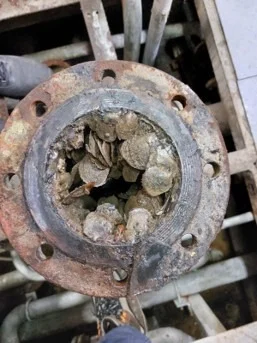
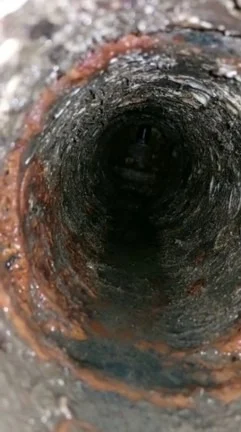
In service: a towage fleet that started with strainers, pipework and plate exchangers on two tugs and now fits ENVSonic as standard across more than 25; MRL Resources, which specified it for the box coolers of four 184 m barges that never move; and S/Y Encore, whose seawater pipework came through full survey after thirteen years with no biological growth. The whole seawater cooling system →
Sea chests in the biofouling management plan
List ENVSonic in the biofouling management plan as the MGPS for each sea chest it protects: type ultrasound, manufacturer GLOBAtech Australia, model ENVS1, the areas from the transducer plan (for example “sea chest, port” and “sea chest, starboard”), and the daily self-test as its monitoring. Log maintenance and any downtime in the Biofouling Record Book. The full plan entry →
Questions
Can a sea chest be protected without docking?
For most installs, yes. The transducers go on the dry side of the chest walls from inside the vessel, so nothing is fitted in the water and the hull is not penetrated. The transducer plan, drawn from the general arrangement and the sea chest drawings, shows where each one goes.
Does it replace the antifouling coating in the sea chest?
No. Ultrasound boosts the coating rather than replacing it: the chest is still coated at every docking, and between dockings growth does not settle on the new coat.
Does it work when the vessel is alongside?
Yes. It does not depend on flow through the chest, so it protects the same at anchor, alongside or under way. MRL Resources specified it at build for the box coolers of four processing barges that never move.
How many transducers does a sea chest need?
It depends on the chest’s size, plating and stiffening, and is set in the transducer plan from the drawings. For a first estimate, the configurator gives an indicative count for your vessel.
Does it protect the strainers and pipework too?
Yes, on their own channels: transducers go on the strainer bodies and along the outside of the pipe, each on a footprint shaped to the pipe’s outside diameter. The seawater cooling system →
Get a transducer plan for your sea chests
Send the general arrangement and the sea chest drawings, or just tell us the vessel. The engineers who design and build ENVSonic reply with where each transducer goes, what it protects and a proposal.
More guides: box cooler antifouling · marine growth prevention systems · the biofouling management plan · what biofouling costs
Sources
- IMO resolution MEPC.378(80): 2023 Guidelines for the control and management of ships’ biofouling
- Australian biofouling management requirements for commercial vessels, version 4 (2026)
- Ministry for Primary Industries (New Zealand): Craft Risk Management Standard: Vessels (2023)
- Anti-fouling and in-water cleaning guidelines, Australia and New Zealand (2015)
- Frey et al. (2014), Fouling around: vessel sea-chests as a vector for the introduction and spread of aquatic invasive species, Management of Biological Invasions 5(1)
- Coutts and Dodgshun (2007), The nature and extent of organisms in vessel sea-chests, Marine Pollution Bulletin 54(7)
- Davidson et al. (2023), Biofouling occlusion of ships’ internal seawater systems, Biofouling 39(4)
- Growcott, Kluza and Georgiades (2016), In-water systems to remove or treat biofouling in vessel sea chests and internal pipework, Ministry for Primary Industries (New Zealand)