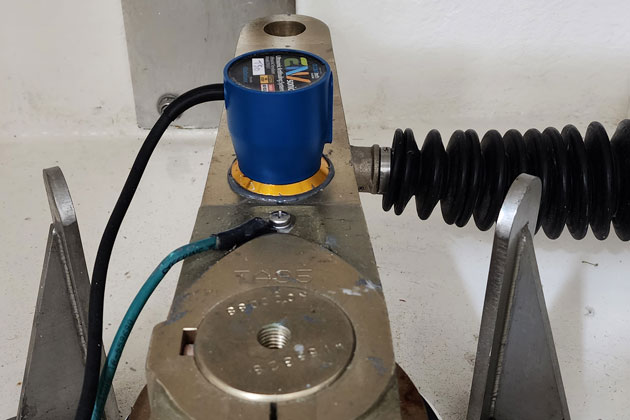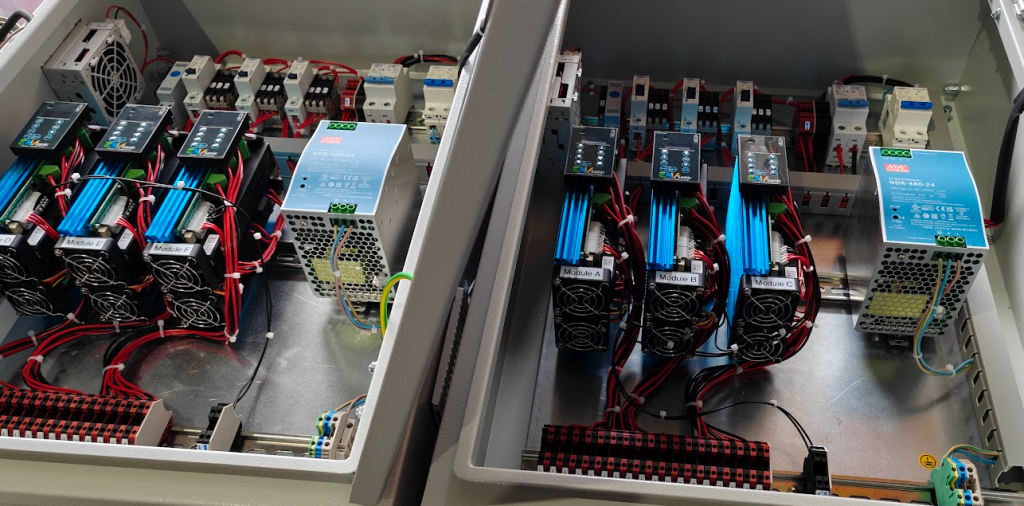
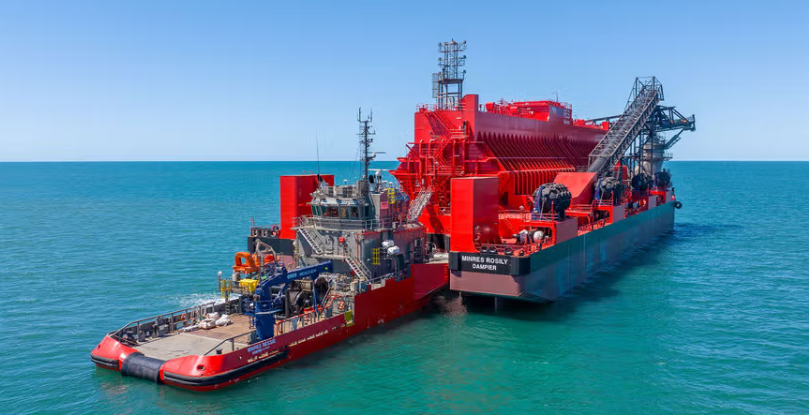
Between 2022 and 2023 Mineral Resources Limited took delivery of four 184-metre stationary processing barges built at COSCO Shipyard in China. Every one left the yard with ENVSonic protecting its box coolers, running from the moment the systems were energised: through fit-out, sea trials, hand-over, the delivery passage to Australia and the long stationary deployment that followed.
The biofouling case for stationary assets
Operators usually model antifouling around vessels at design speed. A stationary processing barge has no design speed and no operational flow. It sits in warm coastal water with sea-chest intakes drawing continuously for the box coolers that support the processing operation, and every minute of every day biological matter settles with nothing to discourage it. A box cooler that lasts 18 months between cleans on a vessel trading to Singapore fouls visibly within months on a stationary barge in a warm anchorage.
Without continuous protection MRL faced reduced cooling performance, periodic in-water cleaning campaigns, ongoing biosecurity exposure under the Australian Biofouling Management Requirements, and a fouling-driven cost line compounding over the asset’s life.
The result
Continuous box-cooler protection across the asset’s life, with no periodic cleaning campaigns, no biosecurity inspection pressure from fouled niche areas, and no degradation of the cooling the processing operation depends on. Ultrasonic protection is agnostic to vessel speed; it works as well on an asset that never moves as on one running flat out.
Why it matters for the wider fleet
FSO and FPSO units, floating processing platforms, mooring and transhipment barges and accommodation barges are the highest-fouling-risk class in commercial maritime by physics, yet their antifouling investment is often modelled against a moving-vessel benchmark that under-prices the real fouling rate. For long-life infrastructure in warm water, continuous ultrasonic protection is materially cheaper than the alternative.
Major Australian resource operators were starting to take fouling-driven biosecurity exposure as seriously as fuel burn, and ultrasonic antifouling, specified at build, became the cleanest answer to both problems at once.
Joshua David, from a founder reflection on the COSCO delivery, September 2023
The MRL programme sits within an installed base of more than 1,000 vessels and assets protected by ENVSonic and its predecessor H2oBioSonic over 17 years, across 14 countries and every major commercial vessel class. GLOBAtech is expanding its OEM and shipyard integration channel, including a partnership with WEKA Marine on box-cooler integration.
Cooling-system protection → · Discuss a stationary-asset deployment →
Adapted from MRL Resources: Four 184m stationary processing barges, first published on globa.tech, 21 March 2024.