
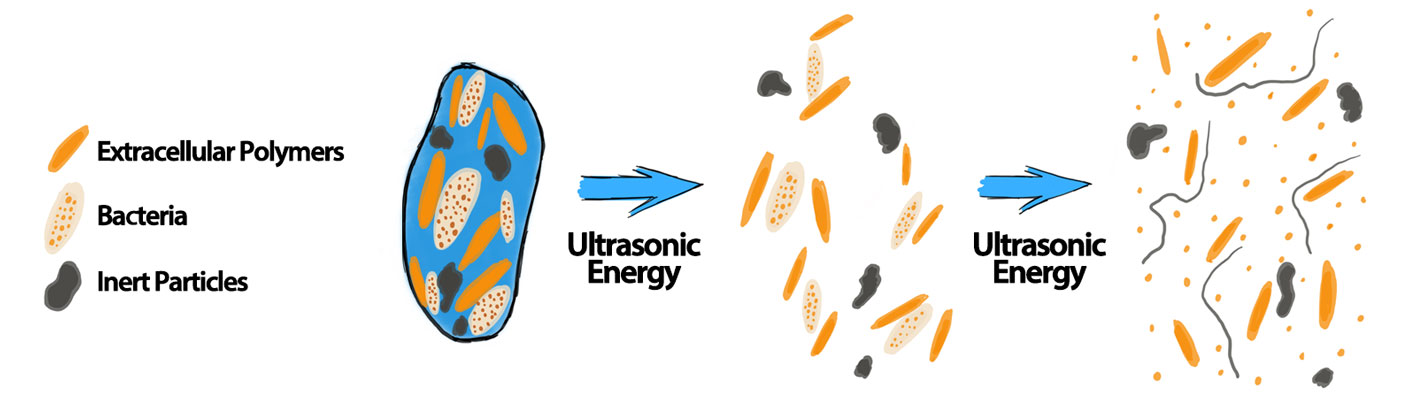
Energy emitted into the structure at targeted frequencies and power levels produces alternating compression and rarefaction in the liquid. Microscopic non-inertial cavitation bubbles form on or near the surface and nucleate on impurities; generating and collapsing them at targeted sizes agitates the surface and damages the cell walls of algae and bacteria, reducing them to inert particles.
What happens at the surface
Bonded transducers transmit curated bursts of ultrasonic energy into the structure at targeted frequencies and power levels. In the liquid at the wetted face this produces alternating compression and rarefaction. Microscopic non-inertial cavitation bubbles form on or near the surface and nucleate on impurities; generating and collapsing them at targeted sizes agitates the surface and damages the cell walls of algae and bacteria, reducing them to inert particles before they can settle.
Why non-inertial matters
Non-inertial cavitation is gentle, stable oscillation of very small bubbles rather than the violent collapse that erodes propellers. It is enough to stop larvae, spores and bacteria attaching, and it does nothing to the coating, the structure or the water column. Nothing is dosed and nothing leaches.
How ENVSonic applies it
The control module profiles each transducer daily to its installed environment, drives it with curated bursts rather than a continuous tone, and shuts a channel down automatically if the transducer becomes unbonded. The proprietary footprint keeps the transducer monolithic with the structure for up to 30% more ultrasonic transference than grease or isolated-face mounting. ENVS1 transducers and footprint →