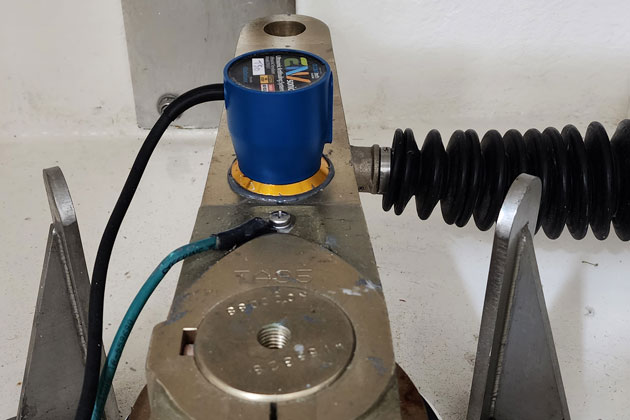
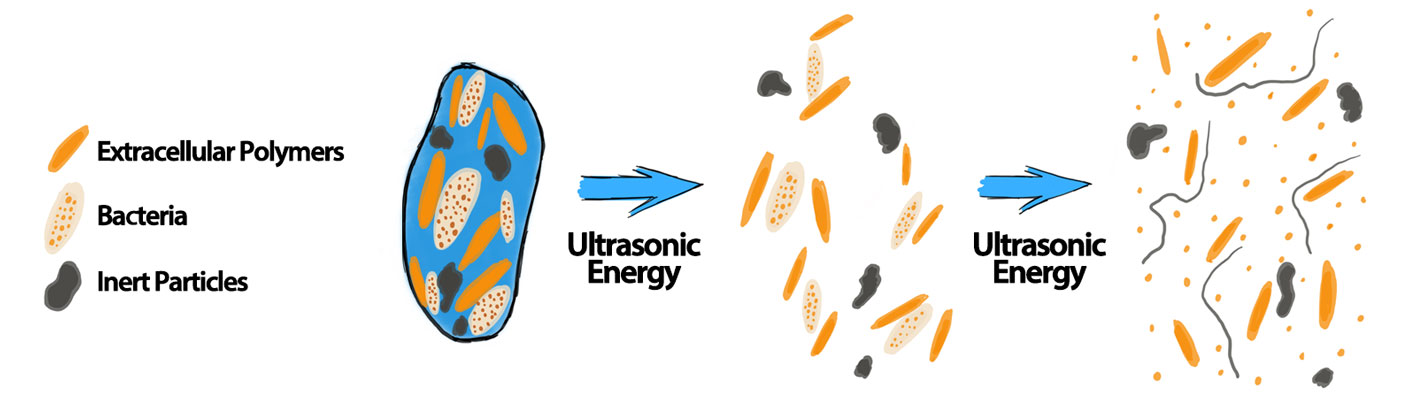
Curated, targeted bursts of ultrasonic energy are transmitted through bonded transducers into the structure. Pressure variations in the water form microscopic non-inertial cavitation at the surface, agitating it, rupturing algae and bacteria cell walls, and making it uninhabitable for settling larvae.
Pressure is the key
Energy emitted at targeted frequencies and power levels produces alternating compression and rarefaction in the liquid. Microscopic cavitation bubbles form on or near the surface and nucleate on impurities. Generating and collapsing them at targeted sizes agitates the surface and damages the cell walls of algae and bacteria, reducing them to inert particles.
Why the footprint matters
The proprietary footprint makes the transducer monolithic with the structure: a watertight seal, electrical isolation and up to 30% more ultrasonic transference than grease or isolated-face methods. No silicone grease to break down and no coarse plastic threads to loosen.
Self-aware, per channel
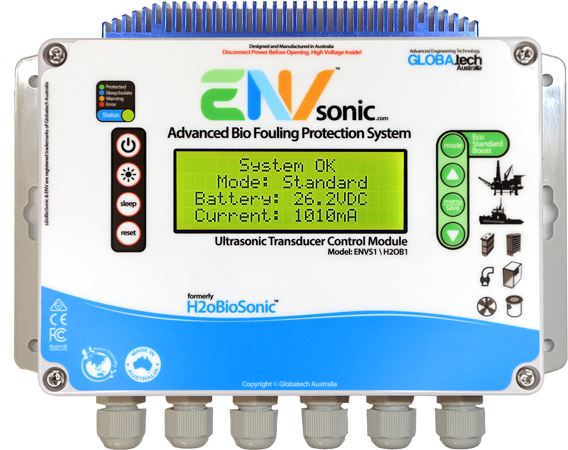
The control module constantly measures temperature, voltage, input and current, and shapes the output with a proprietary algorithm. It monitors each transducer’s health, calibrates daily, detects an unbonded transducer and isolates the channel before damage.